I was deep in character, an irritable old man holding court in the cluttered back room of a run-down McDonald’s, muttering about the useless rookies out front who, unlike me, had never endured real hardship in a kitchen. Suddenly, the door crashed open and an overeager intern burst in; I jumped at the noise and banged my head. Laughter rippled across the room. And somewhere in my pocket, my phone kept recording it all.
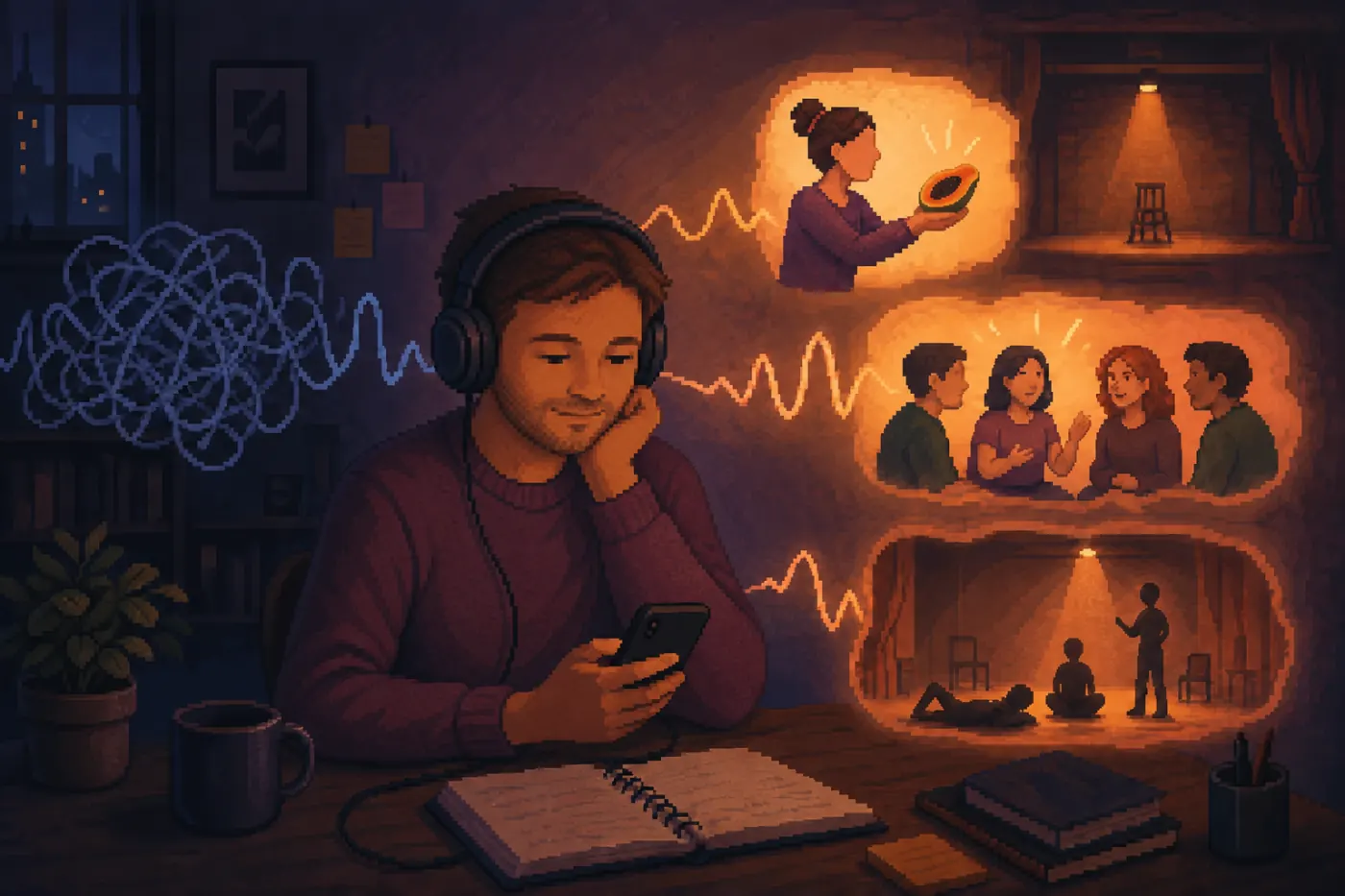
It was all there in the recording: a full two hours, crowded with everything that made that night’s lesson electric inside the room and hard to capture once we left it. Voices tangled and overlapped, eight of us riffing and interrupting, scenes bleeding into feedback, the instructor’s note riding the shoulder of a joke. All the essential mess that makes improv alive was preserved but only if you could find it again.
I did not need a perfect literary transcript. I wanted notes: what exercise did we do, when did a scene begin, how did it become heightened, what made it funny and, above all, what feedback did we get?
I already knew that I was not very good at holding on to everything that happens in an improv class. Because being extroverted does not come naturally to me, simply being in the room already asked a lot of my attention. Recording the session and learning from it afterward began to feel essential. The question was how.
Improv asks me to be completely present. I need to listen to the person in front of me, notice what their body is doing, accept an offer, make a choice and resist planning five lines ahead. A good class fills the mind so fully that there is little room left for taking notes.
Then the class ends.
On the way home I can remember the energy. I can remember that a scene was funny, that an exercise was difficult, or that the instructor said something that made the room suddenly understand. What disappears first is often the useful part: why the exercise worked, what habit it exposed, and how I could practise the lesson again.
I did not want to choose between being present and remembering what presence had taught me. The recording was my attempt to have both.
Later, sitting in front of two hours of audio, I realised that I had not made the evening easier to remember. I had simply saved all of it in a form that demanded another two hours whenever I wanted to find one piece of feedback.
So I tried transcription. That gave me words, but not understanding. Jokes, instructions, scenes and feedback arrived as one long wall of text. I could see what had been said without seeing how the evening had moved. The room had become flatter on the page than it was in my memory.
Adding timestamps helped. At least I could jump back to a particular moment instead of searching through the entire recording. But timestamps only told me where something had happened. They did not tell me why it mattered.
I could have stopped with searchable notes. Instead, I kept working on them. I began separating exercises from scenes, scenes from feedback, and feedback from the explanations around it. I stopped trying to preserve every sentence equally and started looking for the essence: what were we practising, what changed inside a scene, why did the room laugh, and what was I supposed to carry into the next class?
The machine could help me sort and search, but it could not recognise the evening on my behalf. It had not stood in the room. It could mishear Swedish, merge two voices or make a messy exchange sound more certain than it had been. I kept the recording close and listened again whenever the notes looked suspiciously neat.
The turning point came when the words began to recover their purpose. The file was no longer mere notes. The scenes and their teachings were beginning to emerge together.
In the rough transcript, papaya was just a fruit someone had said. In the finished notes, it opened the door to an entire exercise. We had been asked to name a fruit within three seconds. That sounds almost insultingly easy until several people are watching and the mind decides that papaya might somehow be the wrong answer.
The lesson was not to become quicker. We were told to take our time, count to three and then speak with calm and conviction. The pause did not produce a better fruit. It gave us time to stand behind the first one that came to mind.
The fruit was irrelevant. The way we offered it was the exercise.
There was no useful way to prepare. The only way to be ready was to listen. Nobody owned the story, and no contribution was a chance to replace what came before with something better. We held one another’s ideas for a moment, added something, and handed them on.
I often tried to meet uncertainty by thinking faster. I wanted to understand before I moved, find the clever answer before I spoke, and know where a story was going before I accepted responsibility for it. Improv kept asking me to do something that did not come naturally: act without certainty, listen without preparing my reply, and trust that other people would help carry what happened next.
When the notes had been worked on for several sessions finally made that pattern visible, I was almost giddy. I had started with an unwieldy recordings and a weakness I knew well: once the class ended, too much of it slipped away from me. Now I could return to the evening, move through it at my own pace and understand things I had been too busy experiencing the first time.
That felt like conquering something. Not the recording, and not the software. I had found a way around one of my own limitations without pretending it did not exist. I did not have to become the person who remembered every instruction immediately. I could be fully occupied in the room, then give myself the slower second pass I needed afterward.
The class and the notebook became two halves of how I learned. In the room, improv forced me to respond before I felt ready. At home, the notes let me slow down, look again and understand why those uncertain moments mattered. One taught me to leap. The other helped me see what the leap had taught me.
The scenes still vanished. That was part of what made them alive. But the courage, trust and understanding I had found inside them could come home with me.
The scenes could disappear. The learning no longer had to.
Buy Me a Coffee